Summary Insight:
AI collapses roles. Scale demands structure. Every tech cycle follows this pattern—but most founders learn it the hard way.
Key Takeaways:
- Role collapse is temporary. Complexity forces re-specialization. Plan for it.
- Structure determines behavior. Bad structure kills productivity faster than AI can save it.
- AI-fluent superhumans in specialized functions beat generalists piling on hats. Every time.
Facebook just acquired AI-agent company Manus for $2 billion. Their brand position caught my attention: “Less structure, more intelligence.” It captures the prevailing ethos—roll up your sleeves, launch agents, and don’t let organizational structure slow you down.
This sentiment is everywhere right now. Opinion pieces proclaim that AI changes the rules of organizational structure. We’re witnessing a great role collapse where designer, product manager, and software engineer blur together. Why? Because non-technical people can now quickly prototype working products that teams can test and iterate on. A mockup is powerful, but a functioning prototype creates an entirely new level of shared context—and for now, it’s dramatically accelerating product velocity.
So the question becomes: Is structure really the bottleneck holding back world-class businesses?
Here’s the uncomfortable truth: structure is essential to every living system. Without it, there’s no alignment, no coherent response, no life itself.
What’s actually happening is what always happens when society faces disruptive technology. There’s breathless enthusiasm for new ways of working, combined with confusion about what’s genuinely different versus what remains unchanged.
If you’re starting or scaling an AI-native company, it’s tempting to believe the old rules no longer apply. After all, how we work, hire, and create value is transforming at breakneck speed.
But here’s the paradox: the more things change, the more they stay the same. The tools have evolved. The principles haven’t.
AI doesn’t replace sound organizational design—it amplifies it.
This Pattern Is as Old as Industry Itself
To see why, imagine you’re a shoe cobbler at the start of the Industrial Revolution. You live in a small town where you serve the local market. With the available technology, you are everything: designer, manufacturer, marketer, financier, salesperson, and bookkeeper.
Then, in the next town over, capitalists purchase a rolling machine, a sewing machine, and a sole cutter. Seemingly overnight, they mass-produce shoes at a fraction of your time and cost. As their shoes flood your market, you’re forced to take a job at their factory as a rolling machine operator—one specialized role in a much larger system. This is actually a relief to the founding entrepreneur, who had been running all the machines himself day and night.
Here’s the pattern: when new technology arrives, roles initially collapse. At first, generalists who can learn and optimize the new tools thrive by doing everything themselves. Productivity skyrockets.
But as productivity increases, so does complexity. And complexity demands specialization. The roles separate again—not because the old way was better, but because no human or system can manage infinite complexity. Eventually, coordination costs and entropy catch up, and the unbundling begins.
That’s exactly where we are with the current collapse of product management, design, and engineering roles. It feels like a massive productivity boost—and it is. But the bottleneck has shifted. It always does.
We’re simply early in the cycle: first we bundle new and old skills into generalist roles, then we unbundle as scale demands. This is what structural design actually is—knowing when and how to navigate these competing forces.
This pattern repeats every time transformative technology arrives. Which is why certain structural principles become non-negotiable, regardless of the tools you’re using.
The Six Rules of Structure (For the Enterprise AI Era)
Every organization—AI-native or not—is governed by the same structural laws. Ignore these and you invite entropy, no matter how smart your models. The rules don’t change. The tools and speed do.
1. If the strategy or lifecycle stage shifts, change the structure.
Structure must always follow strategy and stage. A startup trying to find product-market fit needs different structure than a scale-up launching its second product line. Violate this and you’ll either move too slowly to compete or collapse under premature complexity.
2. Don’t let short-term functions overpower long-term ones.
Protect innovation, culture, and strategy from constant operational pressure. Without this, quarterly results cannibalize future viability. You win the quarter but lose the decade.
3. Don’t let efficiency override effectiveness.
Systematize only after experimentation proves the path. Premature optimization kills learning. You build the wrong thing faster. You end up working for the systems you designed rather than the other way around.
4. Don’t let central control suppress autonomy.
Push authority and decision-making closer to the work—guided by smart governance. Too much centralization creates bottlenecks. Too little creates systemic risk.
5. Put your superhumans where they can focus and thrive.
We can all be AI-augmented superhumans now—but only if we’re positioned in roles that leverage our unique strengths without cognitive overload. The same thing is true for agents by the way. They suffer from too much cognitive overload too.
6. Process makes structure come alive.
You can only move as fast as your latest bottleneck. Structure without optimized process is just an org chart. Process and agents without structure is just chaos.
These laws don’t change with technology. In fact, if you attempt to violate them using AI, it will ultimately blow back in your face—just faster and at greater scale.
The Four-Quadrant Structure Map: Your Blueprint for Balance
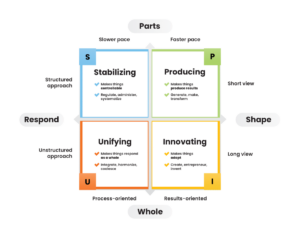
To navigate these eternal tensions, every scalable organization needs a structural blueprint. Not a rigid hierarchy, but a map of competing forces that must remain in balance.
Think of your business as a system balancing two key tensions:
- Short-Range (Execution) vs. Long-Range (Evolution)
- External Focus (Customer) vs. Internal Focus (Enterprise)
Why these two tensions specifically? Because every viable organization must simultaneously execute today’s business while building tomorrow’s—and it must do this both for the market (external) and for its own capabilities (internal).
Together, they form four fundamental quadrants, each representing a set of functions that must be energized for the company to thrive:

These quadrants reflect enduring polarities inside any company: efficiency vs. effectiveness, autonomy vs. control, short-term vs. long-term.
It might seem like AI erases these tensions. It doesn’t. It actually heightens them.
AI accelerates execution (Q1/Q2), which makes long-range thinking (Q3/Q4) and evaluation design even more critical. AI democratizes capability, which makes governance even more essential. AI collapses roles, which makes functional clarity even more valuable.
Understanding these principles is one thing. Applying them is another. Here’s the basics.
Four Steps to Structure an AI-Native Organization
I’m going to lay out the four steps to structuring an AI-native organization next. But before I do, I need to clarify two critical exceptions—because I’m seeing a lot of bad structural advice out there that ignores context.
First: These steps don’t apply to pre-product-market fit startups. There’s an old adage that every business faces two classes of problems: pre-product-market fit ones and post-product-market fit ones. If you’re still searching for product-market fit, don’t attempt to structure your business too early. Focus exclusively on finding product-market fit. Nothing else matters until you do.
Second: If you’re transforming a legacy organization into an AI-native one, everything I’m about to tell you is true—but it won’t be enough. Due to the inertia of your current system, you’re going to need to pilot and prove an AI-native model outside the existing structure. Think of it as building a competitor to your own business, but under your own roof. This is a topic for a separate article, but know that transformation requires a different playbook than new construction.
With these two caveats in mind, here’s how to structure your business:
1. Always Start by Thinking Horizontally
As I describe in my book Designed to Scale: How to Structure Your Company for Exponential Growth, begin every structural design by thinking horizontally.
What does this mean? Structure exists for one reason: to help your organization better serve customers, deliver products, attract and retain talent, and execute strategy without friction.
These are horizontal concerns because they cut across your entire organization. The customer journey, product development cycle, employee experience, and strategic execution don’t respect departmental boundaries—they flow through the whole system. Think of them as continuous cycles that never stop, and your job is to identify and remove bottlenecks that slow them down.
This means if your current structure creates silos, bottlenecks, or fragmentation, something is wrong. Either the structure itself needs redesigning, or you have the wrong people and processes operating within it. Either way, you can’t let it continue.
Both humans and AI agents need clear visibility into these cycles. They need to understand the ideal customer journey, product flow, employee experience, and execution cadence. They need to know who owns each step and where friction is building up. Without these maps, the system can’t self-optimize—it can only thrash.
2. Map Functions
Once you’ve clarified the ideal process cycles your structure must enable, map the core functions accountable for each step—customer journey, product development, employee/agent experience, and strategic execution.
A function is people-and-agent independent. It’s the set of “jobs” that must be performed at each step, regardless of who or what does the work. Sales is a function. So is engineering. So is product management.
Where you place each function in the structure determines its scope, prevents conflicting accountabilities within a single role, and allows you to staff it with highly optimized people and agents working together.
Structure gives an organization its shape. Your brain isn’t in your feet for a reason. You shouldn’t blindly combine product management with engineering, or brand marketing with sales, or manufacturing with R&D. That would be like trying to combine your heart and lungs into one organ. Each supports the whole system with its own distinct purpose and orientation.
The Structure Map concept above helps you identify which function should own each process step—without conflating roles that shouldn’t be combined. For a practical walkthrough, check out my How to Design Your Structure Videos.
3. Place Superhumans Into High-Leverage Roles
Notice we haven’t discussed people, job titles, or reporting lines yet. That’s intentional. If you design structure around your current team and titles, you’ll just get more of what you already have.
But now—having designed horizontal process flows and mapped functions to their proper locations—you can place your team and agents into their best-fitting roles.
What is an AI-fluent superhuman? It’s not about intelligence or pedigree. It’s about capability. An AI-fluent superhuman is someone who has learned to use AI as a genuine extension of their cognition—not just a fancy autocomplete, but a collaborative thinking partner that multiplies their output without degrading their judgment. They know which tasks to delegate to AI, which to keep human, and how to orchestrate both for maximum leverage. The gap between AI-fluent and AI-proficient professionals is now wider than the gap between any previous generation of tools.
Here’s the key: don’t place normal humans into major roles. Insist on AI-fluent superhumans only.
One AI-fluent brand marketer can now cover tremendous ground. They might wear multiple hats—performance marketing, product strategy—until complexity demands further specialization. With this approach, you’re consciously asking them to oversee multiple functions. You haven’t unconsciously collapsed these functions into one. You have three distinct functions with one superhuman overseeing all three.
When it’s time to remove a hat (and this may happen faster than you expect), it’s clear what the current leader should focus on and exactly which role to hire for.
This approach also lets you thoughtfully design and optimize the AI agents executing tasks within each function. Even if one superhuman oversees multiple areas, each AI agent must be specialized for its function. Your coding agent optimizes for code quality. Your product agent optimizes for customer outcomes. Your ops agent optimizes for efficiency.
No single agent does all things equally well. Performance degrades when you pile competing accountabilities onto one agent—just like with humans.
4. Drive and Optimize
With a smart, scalable foundation in place, you’re now in the business of continuous learning and improvement—building a self-adaptive, resilient organization.
The structure evolves as strategy shifts, stage changes, or complexity hits a ceiling and requires further specialization.
It might feel different and faster with AI-fluent superhumans and their agents, but it’s not fundamentally different. The same core patterns and tensions remain—the ones you need to harness for the business to survive and thrive.
This means maintaining roles accountable for data intelligence and distribution, cross-process optimization, and balancing competing needs: short-range versus long-range, efficiency versus effectiveness, autonomy versus control. Someone still needs to make judgment calls on edge cases.
Before long, work looks a lot like work always has—just different.
The rules don’t change. The tools and pace do.
Summary
AI can make it seem like the old rules of structure no longer apply. And if you never understood those rules, that’s exactly what it would look like.
But here’s what doesn’t change: structure determines behavior. If you have no structure, or mindlessly collapse competing roles into one, you’ll quickly hit the limits of your approach.
The principles remain constant: Design for the mission. Make the customer journey, product development, employee/agent experience, and strategic execution as smooth and results-driven as possible. When you hit the next ceiling of complexity, don’t throw out the rules of structure—use them to diagnose where and why bottlenecks are occurring and fix them.
Every technology cycle produces the same breathless proclamation: “This time is different.” And every cycle proves the same truth: the fundamentals endure. The question isn’t whether you’ll face structural limits in your AI-native company. The question is whether you’ll see them coming.
📌 Is your current structure harming execution speed? Find out by taking the Entropy Survey: https://organizationalphysics.com/entropy-survey/