Summary Insight:
Entropy is coming for your company. The only defense is deliberate system design — control and feedback built into every role, human and agent alike.
Key Takeaways:
- Life exists to shape its environment, not observe it. Your company is no different.
- Control requires two things: input/output (the ability to act) and feedback (the ability to learn).
- The more deliberately you design for control, the more you can let go.
“Control freak” is supposed to be an insult. It’s the label we give to micromanagers who can’t let go, who suffocate their teams with oversight.
But here’s the thing — every living organism is a control freak. You are. Your company is. And your AI agents need to be too.
Let me explain.
Life Is Control
Living beings don’t exist to passively observe the world. They exist to shape it. A cell regulates its internal chemistry. A plant turns toward light. A company wins customers. Life is the continuous act of exerting influence over the environment.
Why? Because of entropy.
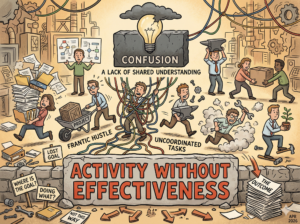
Entropy is a measure of disorder — of uncertainty, degradation, and the loss of useful information. And entropy has a nasty habit: it increases over time. Things decay. Communications break down. A leaky vessel gets leakier. An organization gets slower and more confused unless someone intervenes.
The universe trends toward chaos. Life pushes back.
That push is control.
Control Requires Two Things
Control isn’t just “being in charge.” It’s a system property. And it requires two components working together:
1. Input/Output
A system exerts control by interacting with its environment. It takes in data (input) and produces actions that affect the world (output). A thermostat senses temperature and triggers the furnace. A sales rep reads buyer signals and adjusts the pitch. An AI agent monitors a queue and routes tickets.
No input means no awareness. No output means no control.
2. Feedback
But input/output alone isn’t enough. You also need feedback — the ability to sense actual performance versus expected outcomes and adjust accordingly.
Feedback is how you learn. It’s adjusting future conduct based on past performance. Without it, you’re flying blind. You might be taking action, but you have no idea if it’s working.
Control without feedback is just activity. Control with feedback is adaptation.
So what does this mean for running a company?
The CEO Question
If you’re leading a company, this is the question you need to be asking:
How do I design my organization so that I can control — or at least influence — the right things, while ensuring we have real-time feedback to adjust as one organism?
This isn’t micromanagement. It’s architecture.
You’re not trying to control every action. You’re trying to design a system that can self-manage — that can sense, act, learn, and adapt without you in the loop on every decision.
The irony is this: the more deliberately you design for control, the more you can actually let go.
But if you skip this step — if you deploy agents or humans without clear outcomes to achieve or without real-time feedback mechanisms — you haven’t empowered anyone. You’ve just created expensive chaos.
Become a Control Freak
The companies that win in the AI era won’t be the ones that deploy the most agents. They’ll be the ones that design the best systems — humans and agents working as one to push back against entropy and drive results.
That requires control. That requires feedback. And that requires leaders willing to be conscious and deliberate about the need for both.
So yes — become a control freak. Not the micromanaging kind. The architectural kind.
Design the system. Define the goals. Close the loops.
P.S. If you’re wondering what this looks like in practice — clear authority levels, escalation triggers, transparency requirements, feedback built into every role — that’s exactly what Organizational Physics does. For humans and agents alike.