I’ve been sitting with this line: “You can’t solve the problem from the level of the problem.” It’s easy to treat it like a clever slogan. It isn’t. It’s a structural truth. Problems don’t dissolve from inside the same mindset, assumptions, or architecture that produced them. Harder work and tighter focus just reinforce the loop.
After reflecting on it, I realized this principle explains why certain issues linger for years while others disappear overnight. It also explains how you can resolve a draining, recurring issue in your own life and work—starting now.
But why can’t you actually solve a problem from the level that created it? Four big reasons really:
1. At the same level, the system recurses.
When you stay at the level of the problem, the system recurses. It runs the same pattern again and again because that’s the only pattern it knows how to run.
Recursion means the system feeds on its own logic. It uses the same assumptions, same incentives, same constraints, and then produces the same outcomes—no matter how hard you push.
If you’ve every had the feeling of playing whack-a-mole with the same set of recurring problems, or reliving Groundhog Day in a relationship spat, this is recursion in action.
The existing structure (mental, emotional, familial, organizational) routes energy into the old groove. It defaults to the familiar path, reinforcing the very pattern you’re trying to exit.
This is why spinning feels so familiar: you’re not moving forward. You’re looping inside the same architecture.
2. Every problem has a context layer above it.
Every problem sits inside a surrounding context layer — a frame of history, meaning, incentives, identity, and constraints. This context determines what the system pays attention to, what it ignores, and what it believes is possible.
Stay inside that frame and you inherit its behaviors and blindspots. You’re trying to solve the problem from within the very story that produced it. “You can’t see the full picture when you’re standing inside the frame.”
The right context is the one above or adjacent to the problem — the vantage point that redefines the rules of the game. Shift the context, and the rules shift with it.
Change the frame → change the game.
3. The problem is entangled with the level that created it.
This is where people feel trapped.
Structures work to preserve themselves.
What you’re fighting isn’t a one-off. It’s the expected output of the overall architecture you’re standing in.
You can’t out-think a system while living inside its constraints. To paraphrase Deming, “A bad structure beats good intentions every time.”
This is when trying harder becomes a form of self-sabotage. Will-power fades away, cynicism and pessimism permeate the field. The problem is fused to the frame.
Shift the frame → the pattern breaks.
4. Solutions emerge only when you rise above or adjacent to the frame.
The solution isn’t more positive thinking, or greater effort. It’s to change the structure, including your viewpoint of the problem.
This means stepping into a frame that provides more insight and leverage than the one producing the problem.
You’re not erasing the past or rewriting history. You’re changing the perspective and the design that the system uses to function.
At a higher or adjacent frame, the defaults change:
Different assumptions — the meaning you assign to events shifts.
Different constraints — the boundaries and permissions are redefined.
Different identity — the “who I am” and “who they are” changes its scope and definition.
Different governing principles — a new rule-set organizes behavior.
Different source of attention — what the system considers signal vs. noise evolves.
This new frame reroutes energy, information, and action. As a result, the patterns and beliefs that once held a lot of gravity dissolve away.
At this level, the old problem can’t maintain its structure.
It was propped up by the logic of the prior frame.
Remove that logic, and the problem collapses under its own weight.
That’s emergence:
The higher frame organizes the lower.
How Would You Fix Slow Execution?
Let’s apply this way of frame switching to a common business problem: slow execution. Deadlines slip, meetings drag, and cross-functional work feels like wading through mud. Ever been there?
The instinctive response when faced with a problem like this is to attack it from the same frame. Tighten the screws—add more tickets, more dashboards, more status meetings, and more oversight. But all of those “fixes” operate at the same level as the problem. They reinforce the very architecture that is producing the friction in the first place.
In Organizational Physics terms, slow execution usually has little to do with a lack of control or even from low effort.
When work slows down, it’s usually because the system is misaligned somewhere that matters. Maybe it’s swamped by competing priorities and conflicting accountabilities. Maybe there’s an unrecognized bottleneck. Maybe the information flow is fragmented and no one has a clear view. Maybe the strategy no longer fits the current lifecycle stage. The reasons can be countless, but you won’t fix the issue by tightening the screws. You fix it by shifting the frame.
So what actually improves execution? A structural shift.
Start by stepping outside the frame. Look at the business from a bird’s-eye view and see where it’s gaining and losing energy. Energy is the currency required for anything to happen, and if your business is leaking energy, plug the leaks! You can see categories of energy gains, drains, and their real root causes by running an Entropy Survey.
Next, look at the business on an environmental map, like my Strategy Map, to see the lifecycle stage of the core business and any business units—and to see how well the strategy matches market timing and your stage of development. Sequence matters. If you’re out of step, you’re out of time.
Now you’re ready to design a structure that actually drives the strategy for your next stage of development. Step away from the existing structure, people, and roles and design from a fresh slate. If you don’t, you’ll simply recreate the status quo. Design controls behavior — and the wrong structure locks in the wrong behaviors. You can learn more about the rules of structure and how to design yours the right way by watching my Structure Change Videos or go deeper by buying my book Designed to Scale: How to Structure Your Company for Exponential Growth.
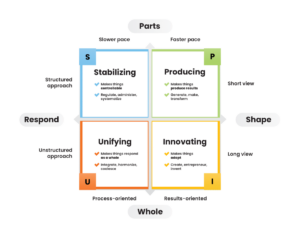
Once your structure is designed to scale, place your current team into roles that match their PSIU styles, interests, and skills. Strip away any competing accountabilities that work against the goals of the structure.
Now you’re ready to launch a team-based strategic execution model that allows you and the team to drive the short-range tactics of the strategy with coherence. The right framework unifies the information flow into a single source of truth, including the core metrics and KPIs that matter. It also allows you to delegate authority to where the real work is happening and stay agile as conditions change. Click here to learn more about my fission-fusion approach to strategic execution teams (SET) and why the right approach mimics nature, not management theory.
Notice the sequence. First, we shifted the perspective and looked at slow execution through new frames by using maps (Entropy and Strategy). Maps help to get you and your team aligned fast on where you are and where you want to go. Next, we designed a structure that scales while removing bottlenecks. Then we energized that structure with people (and agents) who are a strong fit for more focused roles. Finally, we tied it together with a repeatable SET process that drives faster, smoother execution.
The real point is this: we had to shift the frame above or adjacent to the original problem to produce a sustainable solution.
Change the frame → change the results.
In summary, when you try to solve a problem from its own level, you generate more of the same. The system recycles its logic and multiplies more of what its already generating.
Step back from the situation and the principle is clear:
Problems persist when the system attempting to solve them is operating at the same level that created them.
Change the frame and behavior starts to shift.
Upgrade the frame and the old patterns lose their gravity.
That’s the physics of real transformation.