Summary Insight:
AI can replace routing. It cannot replace shared understanding. Companies cutting their sensemaking forums in the name of speed are building execution machines that don’t know where they’re going.
Key Takeaways:
- Accountability is individual. Sensemaking is collective. Confuse the two and execution collapses.
- Every meeting needs one named owner accountable for the decision — not a committee, not consensus.
- Whatever you save automating routing, invest the same amount into team-based sensemaking — the recurring forums where shared context gets built.
This article was originally published on Lex Sisney’s Enterprise AI Strategies Substack.
Nate of Nate’s Substack, whom I enjoy reading, wrote a recent piece on how the management layer of companies is being transformed by AI, correctly and incorrectly: “Valve Got Lord of the Flies. Zappos Got Paralysis. Your Reorg Is Next.” In it, he describes management as consisting of three layers: routing / sensemaking / accountability.
“The three functions are routing (moving information between people and teams), sensemaking (interpreting what that information means for specific decisions), and accountability (telling people whether they’re on track and helping them grow).”
The overall gist is that if your company fires its management layer in an attempt to better leverage AI, you better be careful about which layer you’re cutting.
When I read this, my initial reaction was, “Damn Nate! That’s a very insightful breakdown of management layers. And you’re in my area now, organizational structure and scaling, WTF?!? How did you come up with this neat illustration?” Then I realized that Nate very likely didn’t write this article himself, nor come up with the core concepts — Claude did. And like a lot of things in AI, what can seem brilliant on the surface often has some glaring omissions underneath. My goal with this article is to help you see deeper and avoid some major pitfalls.
The biggest hole is this: sensemaking is not an individual activity, and accountability always is.
Accountability Is Individual
The article references Block (Jack Dorsey’s company that recently cut half its management staff) as being smart for cutting management layers in favor of DRIs (Directly Responsible Individuals) to drive and coordinate cross-functional projects.
A DRI is not a new concept. In my book Designed to Scale, I discuss why having a very capable DRI accountable for driving a singular time-boxed cross-functional initiative with a cross-functional pod is essential to moving the business forward. This is actually how we drive strategic imperatives forward in Organizational Physics — one Big Implementer assigned to each key imperative.
Here’s the principle: you should always have one individual accountable for the success or failure of a given project. Bottom line. Full stop. To be clear, a DRI should really be called a DAI — because by definition, we’re all responsible for the success or failure of our organizations. But a given role should be accountable for key steps. Accountability can be delegated; responsibility cannot.
The article also mentions the frustration of endless meetings with circular discussions because no one knows who is accountable to actually make a decision. This is a really easy problem to solve, and it doesn’t require AI. The simple secret is to never have a meeting without calling out who is the implementer of the decision. That individual is accountable for the decision. Start there and all discussions become much more focused. If they aren’t, that’s good news too — it tells you that you either have the wrong implementer on point, or there is organizational inertia fighting against this project. Both must be addressed if you want the project to succeed. (More on this in Ten Rules for Highly Effective Meetings.)
Every meeting needs one clear, named, accountable owner. Not a committee. Not consensus. One person responsible for what was decided, what happens next, and who does what by when. This single discipline eliminates most of what looks like a sensemaking vacuum — the circular discussions, the Slack threads that spawn more Slack threads, the alignment meetings that produce more alignment meetings. It’s the same root cause every time: nobody was accountable for the outcome of the initiative.
Sensemaking Is a Team Sport
Here’s where the article goes seriously wrong. It frames sensemaking as an accountability that can be delegated — a single person who interprets what’s happening and drives the response. That’s not sensemaking. That’s just routing a decision downstream with extra authority.
Sensemaking is how a team builds a shared world-model — what’s actually happening, what it means for this team specifically, what we need to do about it. That model lives between people, not inside any one of them. It gets built through structured dialogue and shared images. Please, please, please don’t underestimate the power of building shared images across your organization! Mental models get tested through disagreement. They get updated through shared experience and understanding.
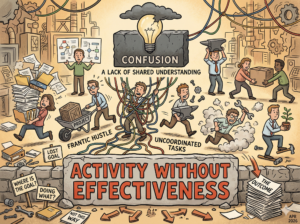
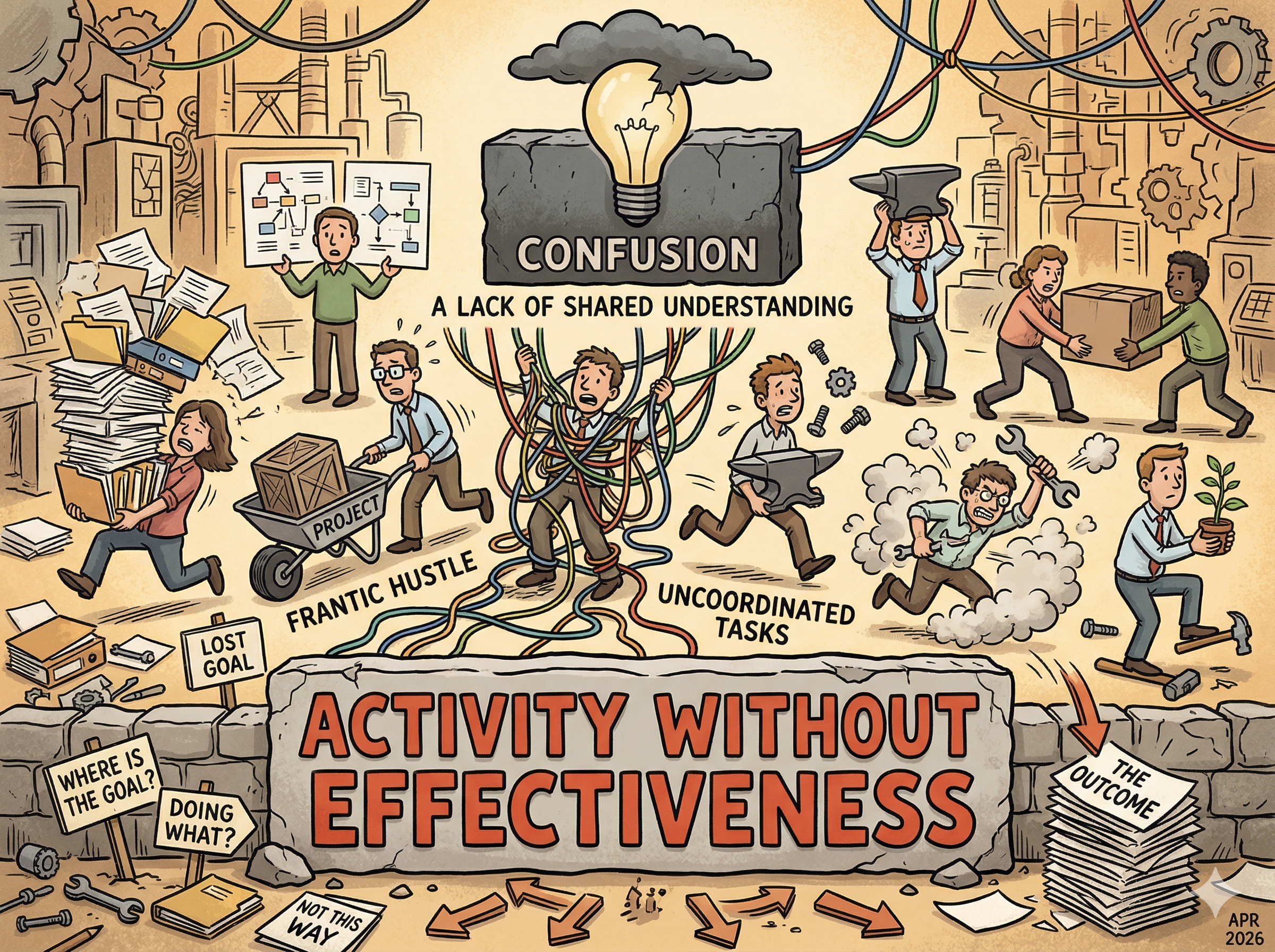
When you try to bypass sensemaking for speed, you’re going to create a lot of activity. A lot of agents. A lot of work product. But if your shared context isn’t set up correctly and reinforced continuously, you’re going to amplify noise, not results. The bottlenecks will still emerge — they’ll just be downstream of where the sensemaking should have happened.
This should be intuitive. Imagine you launch a new initiative with a DRI assigned and give them budget and authority to form up their pod and get after it. But you skip the shared sensemaking step. Man, oh man, do I feel sorry for that DRI. They’re going to run into a buzz saw of internal resistance. Why? Because the organizational mass is already supporting the status quo, not what is new, different, and a potential threat. The team doesn’t have a shared model. They have orders they didn’t participate in building. The resistance will be very real.
And if your answer is, “Fine, then fire all the humans getting in the way and just run agents, they don’t need sensemaking.” Well, if that’s you, then I have some beachfront property to sell you in Nevada. Agents do indeed need shared context. Without it, you get lots of activity with poor alignment and outcomes. Just like you do with a team of humans.
The Rule of Thumb
Whatever you save by automating routing — and you should automate it aggressively — invest the same amount into building the sensemaking process. Not concentrating it in a single person. Building it as a recurring team practice. This is why I call the CEO the Chief Context Officer… context building and reinforcement is sensemaking!
Most companies do the opposite. They cut the coordination meetings, call it efficiency, and destroy the forums where shared understanding was being built. Then they’re puzzled when execution diverges and the same strategy memo produces six incompatible responses.
You shouldn’t have a meeting unless there’s a need to do sensemaking and realignment. But if there is — you should have a well-run, recurring process for it. Build shared consciousness as a team about what’s happening now. Then, with authority vested in the implementers, realign on what to do next. Because this is a team process, the team understands the why behind the decision. They get a chance to shape it. The resistance that would naturally be there goes down. The organism acts as one.
I know the refrain: “too many meetings.” And it’s true — there likely are too many bad meetings happening. But that’s not a communication problem. It’s a poor sensemaking process, which is exactly why companies misdiagnose it and respond by adding more Slack channels. But you tell me. Are your Slack channels overwhelmed by too much noise and not enough shared sensemaking?
The SET Model
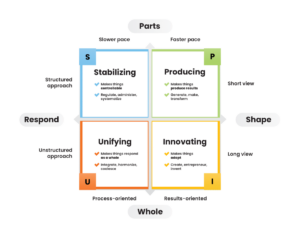
In the SET model I use when working with all organizations, AI native or not, the head is responsible for building shared understanding – sensemaking – across their organization and team.With the right context and structure built, execution capacity can be delegated to do the work. The team must consistently re-read the environment together – with a shared mental model – and work to support the implementer in executing fast. Repeat.
Agents can replace routing. That part Nate gets right.
But when routing through humans disappears, the head’s job doesn’t shrink. The head becomes a full-time builder of shared understanding — reading the field with the team, making the hard calls, owning outcomes. Every flat-org experiment broke on this same misunderstanding. The assumption was that eliminating routing made the head’s job smaller. It doesn’t. Routing disappears and what’s left is pure judgment. And sound judgement can’t be made in isolation. The head becomes more important, not less — which is the opposite of what most “unbossing” initiatives are planning for.
The Prescription
Automate routing aggressively. It’s available now.
Name one clear accountable owner for every project and every initiative. No exceptions.
Invest more into team-based sensemaking, not less. The recurring forums where shared understanding gets built are exactly what flat-org experiments destroy, and they’re the hardest thing to reconstruct once they’re gone. The companies that automate routing, appoint DRIs, and call the sensemaking problem solved will revert quickly. The companies that treat sensemaking as a team practice — something you build, not something you delegate — will have an architecture that allows them to adapt and thrive because the organism can sense and respond within the same shared context.