Summary Insight:
Your company is a brain trying to minimize surprise. AI amplifies whatever structure you have—broken or scalable. Rather than asking “Where do we use AI?” ask “Is our structure ready to amplify the outcomes we want it to?”
Key Takeaways:
- AI doesn’t fix broken structures. It accelerates them. Rigid systems fail at machine speed.
- High-performing companies work like neural networks: interconnected, adaptive, learning from outcomes—not locked in rigid plans.
- Intelligence is abundant. Alignment is the bottleneck. Structure determines whether AI becomes rocket fuel or crashes faster.
Also available on Lex Sisney’s Enterprise AI Strategies Substack.
The brain’s job is to minimize surprise. It constantly updates its beliefs and takes action to align reality with expectation.
When I reach for my morning coffee, my brain predicts: hand grabs cup, cup hits lips, I taste coffee. If I fumble, that’s a negative surprise—the gap between prediction and reality.
My brain updates its model. I focus more. Switch to a better cup. Same mechanism, better outcome.
That’s exactly how a high-performing company should work.
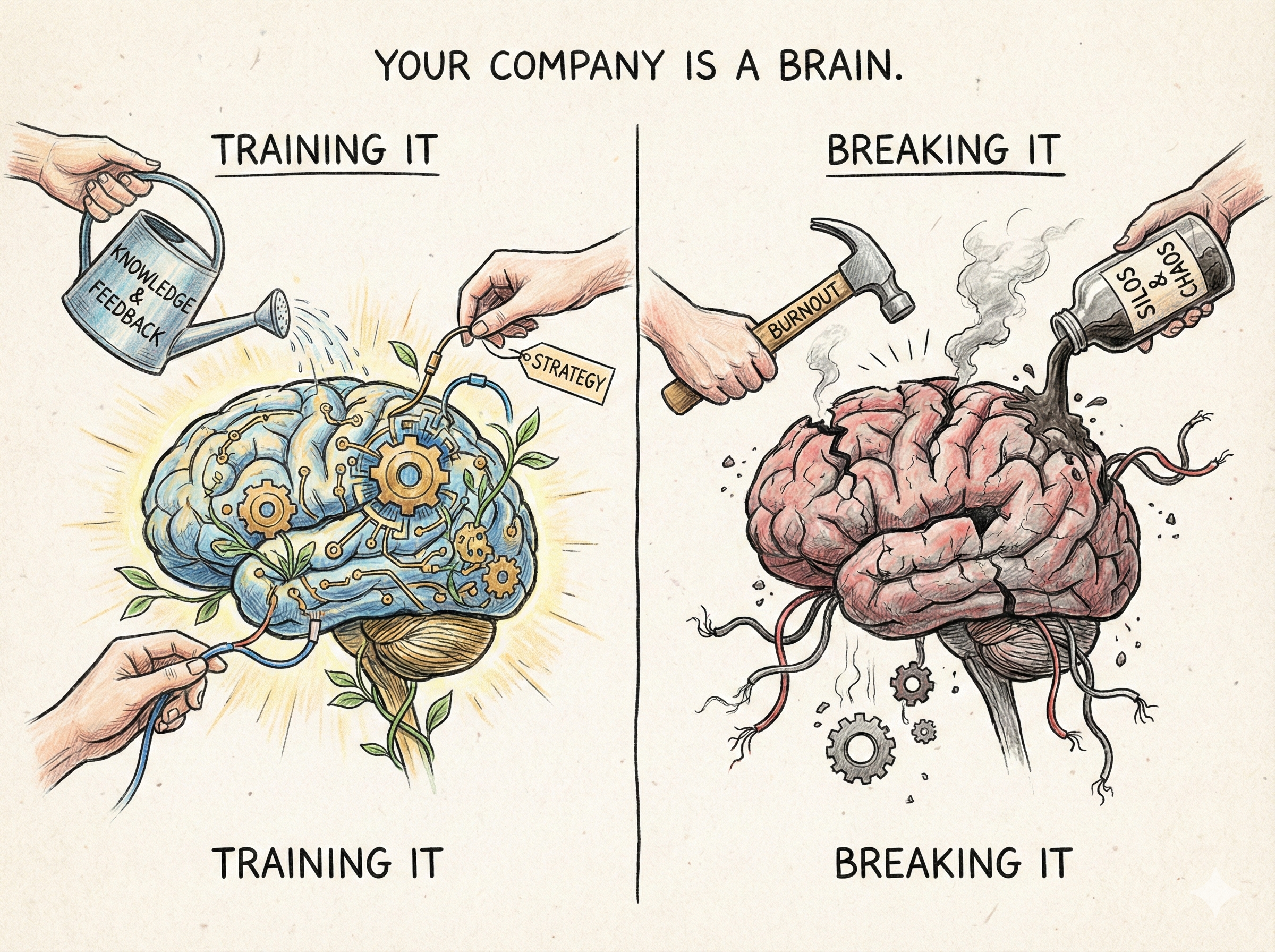
Your Company Is a Brain
Imagine your company as a giant brain. Its people, culture, structure, and systems are like neurons—working together to predict, act, and adapt.
Your job as a leader? Train this brain to minimize surprises and stay ahead.
There’s a dumb way to do that. And a smart way.
The Dumb Way: Over-Control
You try to eliminate uncertainty through rules, KPIs, compliance systems, and rigid plans. You pretend the future can be tamed like a spreadsheet.
That’s like programming a traditional computer—deterministic, precise, and brittle.
Great in theory. Collapses in reality.
Now add AI to this structure. What happens? The brittleness accelerates. AI automates your misaligned outcomes faster. It makes your rigid systems fail at machine speed instead of human speed.
The Smart Way: Neural Adaptability
You build your company like a neural network.
Neural networks are probabilistic. Adaptive. They embrace ambiguity. They update themselves based on outcomes. They learn.
They don’t aim for perfection. They aim to predict better.
Add AI to this structure? Now you’re cooking. AI accelerates your feedback loops. It spots patterns your teams would miss. It extends your world model into territory you couldn’t reach before.
Same technology. Radically different outcomes. The difference is structure.
How’s Your World Model?
A world model is your company’s internal simulation of reality.
If your organization has a shared, evolving model of itself—people, goals, friction points—and its environment—customers, competitors, trends—it can predict, act, learn, and improve.
If you lack that model? Or worse, if every department uses a different one?
You know the answer.
Here’s an exercise: Poll your leadership team. Poll your agents. Ask: What’s your view of our customers, competitors, and internal friction points?
If answers differ, you’ve got work to do.
AI Amplifies Everything
Here’s the thing most companies get wrong about AI: they think it’s a tool. Something you bolt on.
It’s not. It’s an amplifier.
AI doesn’t fix a broken structure. It accelerates it. If your teams are siloed, AI will automate those silos—faster miscommunication, greater misalignment, more fires to put out.
If your feedback loops are slow, AI will generate insights nobody acts on. If your world model is fragmented, AI will optimize for local wins that create global losses.
But if your company is already designed like a neural network—interconnected, adaptive, learning—AI becomes rocket fuel.
Intelligence is abundant. Alignment is the bottleneck.
The companies winning with AI aren’t the ones with the best models or the biggest budgets. They’re the ones whose structure was ready to absorb and direct that intelligence.
So before you ask “How do we use AI?”—ask “Is our structure ready to be amplified?”
Designing Your Company Like a Neural Network
Neural networks thrive on interconnection, adaptability, and iterative learning. Here’s how to build yours:
1. Interconnect Your Teams Like Neurons
Neural networks work because nodes talk fast. In your company, that means breaking down silos and creating real-time communication across teams.
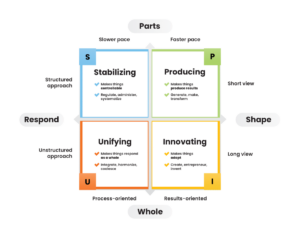
Use the Organizational Physics’ Four Quadrant Structure Model: align customer-facing teams (Q1) with operations (Q2), innovation (Q3), and back-office support (Q4). Each quadrant processes inputs—customer feedback, market trends—and sends outputs to others.
Example: A company I advised centralized demand generation and e-commerce services (Q1) to serve four distinct brands. Shared data flowed between teams like neural signals.
Result: The company’s brain could finally predict what was coming. Mismatched pricing and misaligned campaigns—negative surprises that used to cost thousands per incident—dropped to near zero. Conversions jumped 15%.
2. Build Adaptive Feedback Loops
Neural networks learn by adjusting weights based on outcomes. Your company should too.
Create fast feedback loops to update your world model continuously. Use real-time data—sales metrics, customer sentiment—to adjust tactics weekly, not quarterly.
Identify entropy—the friction points draining energy from your system—and resolve them fast.
Example: A retail client set up daily sales huddles to spot trends early. They caught a 20% drop in demand for a product line and pivoted marketing that week. .
Result: They minimized the surprise before it became a crisis. Under the old quarterly review system, they would have bled cash for months before even detecting the problem.
3. Distribute Decision-Making
Centralized control kills adaptability. Neural networks distribute processing across nodes. Your company should too.
Push authority to where the work gets done. Give teams the autonomy and resources to match the complexity they face.
Let your sales team adjust pricing within a range to match local conditions—rather than waiting for HQ approval.
Example: A CPG firm gave regional managers budget autonomy to respond to local competitors.
Result: Response time dropped from 30 days to 3. When competitors changed tactics, the regional brain predicted and countered immediately—no more getting blindsided by market shifts. Market share grew 10%.
4. Train Your Company to Learn
Neural networks improve through training. So must your company.
Run experiments. Measure outcomes. Scale what works. Treat failures as learning opportunities, not punishments.
Test a new customer acquisition channel for one brand. Measure ROAS. If it exceeds 5:1, roll it out to others.
Build a culture where teams share lessons weekly, refining the world model together.
Example: A healthcare chain tested a new triage system in one clinic. Wait times dropped 30%. They scaled it company-wide.
Result: The system learned to predict patient flow patterns and staff accordingly. Negative surprises—unexpected rushes, understaffing—became rare. Patient complaints cut in half.
5. Scale with Resilience, Not Rigidity
Neural networks are resilient because they adapt weights, not structure. Your company should scale the same way—flexible systems, not bureaucracy.
Automate data flows (CRM to marketing) to reduce manual errors. Create cross-functional roles to handle unexpected disruptions.
Example: An e-commerce firm automated pricing adjustments across platforms during a supply chain crisis.
Result: As costs fluctuated wildly, their system predicted and adjusted in real-time. Competitors scrambled to update spreadsheets manually—always reacting too late. This firm minimized the surprise gap and maintained 60% gross margins while others bled red.
Why Organizational Physics?
Organizational Physics is your company’s neural network blueprint.
It’s a foundational world model that aligns your team—like neurons syncing in a brain—so you can predict, adapt, and scale without bureaucracy.
Built on first principles of physics and systems theory, it cuts through noise: language, culture, personal bias. Anyone in your company, no matter their background, can grasp the core concepts fast.
When you teach and reinforce Organizational Physics, you create a shared world model. The team aligns around shared intentions. Anticipates outcomes. Reduces negative surprises. And evolves the model to fit your unique environment.
Intelligence is abundant. Alignment is the bottleneck.
Design. Delegate. Design.
📌 P.S. Want to build a shared world model for your leadership team? Check out the Strategic Alignment Pro Tools .