The Innovator Style


The Innovator is focused on driving change while finding new and better ways of doing things. To get an intuitive sense of the Innovator’s qualities, think of a dynamic, creative, big-picture person who has a plethora of new ideas and is usually excited by the latest one, until a new one strikes again. That’s an Innovator. If you put this person in a rowboat and say, “Row!” What will they do? Well, they’ll start to come up with new ideas! “Why don’t we put a sail on this baby? How about a glass bottom? That would be pretty cool! Come to think of it, a 250hp motor would do just the trick; I bet we can find one at the marina. Be right back.”

The Innovator has a tremendous ability to peer into the future and to anticipate how seemingly disparate trends will (or can be made to) merge together. They are highly conceptual and get easily excited about new ideas and opportunities. Because an Innovator can sense change occurring faster than other styles, they spend a lot of time trying to get others to see the same thing they do. They usually attempt to do that by explaining the idea and sharing their enthusiasm, and by trying to get others to understand and be enthusiastic too. Our best Innovator qualities are our ability to anticipate change, to be imaginative, charismatic, and inventive. Without the Innovator force, we would have no ability to adapt to changes in our environment and we would quickly become irrelevant or extinct.

The Big I

When the Innovator trait is exceedingly strong, we call it a Big I. A Big I is like a mad genius. It’s always cooking up one crazy sounding idea after the next. The Big I comes into work whenever they want and leaves work whenever they want. If they have an office, it’s likely a testament to their own unique individuality and creativity. The Big I doesn’t like to have meetings unless it’s to discuss a new idea and as long as they get to do most of the talking. Their biggest frustration is that things are stymied in production and implementation or that they get bogged down in managing release schedules and milestone dates, rather than working on the next new thing. Their common complaint is that others “don’t get it.” Their answer to most problems is to come up with a new idea.

The Big I is not usually comfortable giving schedule estimates because they recognize they just don’t have the interest (or a clue) as to how long something will actually take. Those are details for others to figure out. But they’re happy to give predictions on when market trends will converge. However, because they see a future (not necessarily the accurate future) so clearly, they tend to overestimate when something will actually occur. Therefore, if they think the market demand will tap out in two years, in reality it’s probably just getting started then. But if and when demand finally does arrive, the Big I is already bored with it — OMG, that’s so last decade! — and has moved on to yet undiscovered things.

The Big I gets bored with the status quo really easily. Their past creations are never good enough because something new keeps being invented. If there’s nothing new to build or think about, they prefer to destroy what’s already been built. “Hey, let’s tear this old thing down and rebuild something new.” If you walk into their office, the first thing you’ll hear about is their latest idea and why it’s important and revolutionary. When this person supervises others, there’s a lot of chaos among the staff, projects, and schedules. They’ll usually have a right-hand person who suffers while trying to keep up with the extreme amount of innovation, has learned to separate a passing notion from a true need for implementation, and struggles to coordinate all the moving pieces.

The reason that the Big I always pursues so many different ideas and opportunities is that they’re afraid of standing still and being trapped. To stand still is risk boredom and there’s not much more terrifying than that. So to ask a Big I to focus on one thing and complete it is like asking a crack addict to put down the crack pipe. It’s very, very hard and not a lot of fun at all.

In the hit 1985 movie Back to the Future, Christopher Lloyd plays Doc, a madcap inventor and a pretty good depiction of a really Big I. He always seems to have three new ideas running through his head; he has a garage full of half-completed inventions; he’s enthusiastic; he loves to think big; and the viewer is never quite sure if he’s for real or insane because he’s so far out there on the edge. Notice when he’s most happy — when one of his ideas finally works! This clip is in a non-English language. It doesn’t matter. The qualities of the Big I are easy to spot in any language.

Big I Under Stress

When the Big I is under extreme stress, they tend talk themselves into a corner. Because they see so many options, it’s hard to choose one. Thus, they’ll want the flow of options and counter options to stop so that they can pick a path and get out of the mess they’ve created. The Big I tends to seek escape when under duress. So if things are going poorly in the office, you can expect to find them thinking of a new idea, dreaming of a vacation or a fun new purchase, diving into entertainment, or generally trying to avoid reality. When angry, the Big I can get very volatile and hypercritical of others.

Big I and Other Styles

The Big I appreciates Producers because they act really fast to implement their vision. However, sometimes it can be frustrating to have to explain to the Producers why the Big I is changing the strategy again. “Can’t they see it? It’s so obvious!!” Besides, they are kind of boring and uncreative. They absolutely loathe Stabilizers who are finicky, slow, and say “no” a lot! They distrust other Innovators and view them as arrogant competition. They enjoy Unifiers because the Unifier is easy to be around, always has a supportive and encouraging word for their latest idea, and can be a useful ally in galvanizing support for their latest vision.

Managing a Big I

If you’re managing a Big I, you have an outstanding idea generator and a terrible implementer. If you have a good relationship, they’ll want to bounce new ideas off you frequently because they need to talk things through and weigh different possibilities. Often they can be scattered and inconsistent so you’ll need to make sure that the work is actually getting done and that the details are being well managed. Because the Big I is capable of generating so many new ideas, they are often unaware of how the changes they propose are hard for everyone else to keep up with. They overlook the intricate details involved in implementation and conveniently forget all of the half-completed projects they’ve left in their wake. If you praise them for having great ideas and get excited with them, you’ll have a loyal employee.

If Your Boss is a Big I

If your boss is a Big I, you will need to demonstrate your value by helping them complete the pieces of the puzzle they see in their mind. But whatever you do, don’t add to or change the vision for them. That would be like taking their paintbrush and drawing on their half completed canvas. It’s very risky and the Big I may never forgive you for it. Instead, ask questions, gently point out gaps in the planning, and always try to be enthusiastic about their ideas. Because a Big I changes their mind so frequently, you’ll need to be able to discern between a passing notion and real action item. “Oh that, we’re not doing that any more, I changed my mind this morning. Didn’t I tell you? Here’s what we’re doing now…” is something you’ll hear frequently.

The Big I thinks and speaks conceptually in big patterns and generalities. They see things others just can’t. They promote people who they believe can help them achieve their vision. They fire people who no longer fit the vision or who seem to be creating obstacles to achieving it. If they are away on a long airline flight, you can expect them to show up at the office with a list of fifty new ideas and improvements.

The Big I can’t stomach saying “no.” For them, saying “no” means shutting the door to new opportunity. If you present a proposal to a Big I and they do say “no”, unlike a Big S, you can’t go back and try again. That’s it. It’s over. They’ll likely snap your head off if you try again. Consequently, a “yes” from a Big I doesn’t really mean “yes” either. A “yes” for a Big I is more like “sure, sounds pretty good, let’s explore it more.” For example, if you were to ask a Big I, “Mr. Jones, what do you think about this new prototype?” and Mr. Jones responds, “Hey, I like it! Very cool! We could also make it do this…” That’s not a legitimate go-ahead signal. When Mr. Jones comes back in two weeks and you show him the progress on the prototype, he’ll probably say something like, “What? Why are you working on this? I didn’t approve of this. It’s time you focus on the XYZ project, we’re already three months behind schedule!” So a “no” is a final “no” from a Big I but a “yes” is more of a “maybe.”

Summary of the Innovator Style

To recap, Innovator qualities are what allow us to sense and adapt to change and to find creative solutions and new opportunities. Innovators are creative and dynamic. They have an innate ability to see things others can’t yet see. When taken to an extreme, the Innovator turns into a Big I and can become overzealous in pursuing too many different strategies, all half-baked and constantly changing.

Back to The Management Guide

Next to The Unifier Style


1. Ichak Adizes, Management/Mismanagement Styles, Santa Barbara: Adizes Institue Publishing, 2004.

Share the love

The Stabilizer Style


The Stabilizer is focused on how to do things and working methodically to get them done the right way. To get an immediate sense of the Stabilizer’s qualities, think of a very structured, process-oriented person who likes to analyze the data before making a decision. This person is highly organized, has outstanding attention to details, and takes their time in their words and actions. That’s a Stabilizer. If you put this person in a rowboat and say, “row!” What will they do? Well, first they’ll analyze the rowing mechanism and plan the most efficient stroke. Then they’ll want to understand where they are rowing, for how long, what the best route is, when the water and food breaks will occur, and the prevailing winds and currents. Once everything is planned in detail, with two contingency plans in place, then they’ll start to row!

The Stabilizer has a tremendous ability to find better, more efficient ways of doing things. They excel at organizing, planning, controlling, and systematizing things. They create order out of chaos and usually have outstanding retention of pertinent details. The Stabilizer tends to value control over freewheeling innovation, unless that innovation can be analytically justified. They have little patience for errors, sloppiness, or anyone or anything violating a defined process or procedure without good cause. A Stabilizer is methodical and makes decisions based on analyzing the data and finding more efficient solutions. Naturally, it takes time to gather and analyze data and to understand the intricate details involved in a decision. Consequently, the Stabilizer moves at a deliberate pace in their thoughts, words, and actions.

The Big S

When the Stabilizer trait is overly high, we call it a Big S. A Big S is like a bureaucrat that seeks to control for change by establishing and following processes. They value efficiency over effectiveness, even to the extreme. The Big S comes into work on time and leaves on time. If they have an office, it’s likely very clean and orderly with files neatly arranged and spreadsheets and objective data readily on hand. The Big S schedules regular meetings and always has an agenda prepared in advance. Their biggest frustration is that others aren’t following the process. Their common complaint is that others don’t pay close enough attention to important details.

The answer to most problems for a Big S is to analyze the data and document a plan. Because of this, they tend to falsely believe that proper planning can account for any contingency. Therefore, when getting schedule estimates from a Big S, recognize that the schedule will look excellent on paper. It will be very specific, down to each nut and bolt, but also totally incorrect because change is a constant. Consequently, there will likely be several creative ways to accomplish the same objective but much more quickly.

If you walk into their office, the first thing you might hear is how there’s a need for more process and control. When this person supervises others, there are usually a lot of other Stabilizers on the team because the Big S values adherence to standards and protocols as a top priority. They delegate frequently and monitor the work being performed using project plans and milestone reviews. Unlike the Big P, a Big S can’t manage a crisis well. There’s too much noise and confusion for them to quickly and accurately get a read on the situation.

In the 1954 movie The Caine Mutiny, Humphrey Bogart, plays a Big S. His character, Lt. Cmdr. Philip Francis Queeg, is a naval captain in WW2. He’s leading a ship into battle but he’s not focused on the important things such as the enemy, the morale of the crew, or the fighting condition of the ship. Instead, he’s consumed by following the inane procedures and protocols of the Navy to the letter. That’s a Big S. They’ll follow a process to the letter but miss the spirit of the intent, even if it means a mutiny by the crew. The following scene shows how Queeg attempts to find some missing strawberries from dinner. :)

Big S Under Stress

The reason that the Big S must always plan is that they fear a lack of control. For them, a lack of control leads to bad things happening. So to ask the Big S to move more quickly, be creative, or take a huge risk is to ask them to face their biggest fear. When the Big S is under extreme stress, they tend to withdraw inwardly and focus on unimportant but controllable details. For example, Humphrey Boggart in the classic movie The Caine Mutiny played an extreme characterization of a Big S in the role of Captain Queeg. When under stress from a life or death naval crisis at sea, Captain Queeg could only resort to enforcing rules about the consumption of strawberries and his crew was forced to mutiny to survive.

Big S and the Other Styles

The Big S gets along really well with other Stabilizers because they value process, control, and planning. They don’t mind Producers as long as the Producer is not violating any procedures. But if they do, watch out. They distrust fly-by-the-seat-of-your-pants Innovators because Innovators have three new ideas per week, all of which cause more work and headaches for the Big S. They find Unifiers to require way more interpersonal connection and emotional support than they’re willing to give, so they prefer to avoid them entirely. If avoidance isn’t an option, they’ll smile tightly and find an excuse to get back to their private office where they don’t have to engage in intimate conversation.

Managing a Big S

If you’re managing a Big S, you rarely have to worry about them making errors and omissions. Instead, you need to be alert that they don’t fall into paralysis by analysis. A Big S needs lots of structure in their tasks and the best way you can support them is to give them the relevant data to analyze and then allow them time to process it. Be mindful also that, because the Stabilizer is outstanding at understanding the details, they may have blind spots around how the work is impacting others, how the big picture has changed and thus impacts the work being performed, and/or the real work effort involved in executing the plan. If you praise them for being accurate and thorough, you’ll have a grateful employee.

If Your Boss is a Big S

If your boss is a Big S, don’t expect a warm and open door policy but do expect a highly controlled and efficient work environment. If you have a need or a request to make, expect to hear “no” a lot since it’s hard for a Big S to say “yes.” This is because they tend to need a lot of information and time to analyze an issue before committing to a course of action. Therefore, a “no” from a Big S is more like a “not yet, I need more information.” Even if you get a “no” from a Big S, you can usually return with more information and revisit the decision later. Once you get a “yes” from a Big S, you can take it to the bank. It’s very unlikely that they’ll change their mind.

The best way to get a Big S to take action is to point out how something is violating an existing policy. If you can do that, mountains will move. If not, the next best course of action is to point out how the new decision will improve efficiency for the organization. But don’t try to appeal using your personal needs or by pursuing an innovative risk. For example, if you need a raise, don’t say, “My husband lost his job and we can’t afford to pay the bills.” That’s a personal appeal and it will fail. Instead say, “According to HR Policy 254, Level 2 employees shall be rewarded per annum by 5%.” And then make a case that based upon your job duties, you actually should be reclassified as a Level 1 and thus earn a higher salary.

Summary of the Stabilizer Style

To recap, the Stabilizer qualities are what allow us to be accurate, secure, and efficient. It permits the factual, deliberate, and methodical approach to planning and decision-making and creates a sense of order out of chaos. It promotes high quality and follow-through. It helps us to be cautious, thoughtful, and prudent when faced with the unknown. When taken to an extreme, the Big S becomes a liability by always valuing efficiency, even at the cost of effectiveness, and is at risk of paralysis by analysis.

Back to The Management Guide

Next to The Innovator Style


1. Ichak Adizes, Management/Mismanagement Styles, Santa Barbara: Adizes Institue Publishing, 2004.

Share the love

The Producer Style


The Producer is focused on what to do now and working hard to get it done rapidly. To get an immediate sense of the Producer’s qualities, think of a fast-charging, focused, determined, high-energy person who thrives on working long and hard. That’s a Producer 1. If you put this person in a rowboat and say, “Row!” What will they do? Well, they’ll just start rowing straight ahead — and fast! They don’t need to ask questions, plan a route, understand where they should go, or even how long they’ll be gone. They just row and keep rowing until you say, “Stop!”

The Producer has a tremendous capacity to work hard to accomplish a goal and takes great pride in winning. That could be winning the new account, completing the project, achieving a goal, or beating the competition. A Producer is decisive and makes decisions based on what can be accomplished now, without waiting for all the information to be in hand. Instead, they figure it out as they go. Our best Producer qualities are our ability to act, lead the charge, overcome obstacles, urge a team to action, and be effective, assertive, and victorious. A Producer is a lot like the engine of a car. The bigger the engine, the faster the organization can go.

The Big P

When the Producer trait is exceedingly strong, we call it a Big P. A Big P is like a hammer. It sees every problem as a nail and the solution is to hit it. Hit it with hard work, more work, and faster work. The Big P comes into work very early and leaves work very late. If they have an office, it’s likely very messy with lots of projects and tasks to complete (and usually awards and trophies on display). The Big P doesn’t like to have meetings unless they’re short, to the point, and focused on the most pressing task at hand. Their biggest frustration is that things aren’t getting done fast enough according to their own internal clock. Their common complaint is that others aren’t working as hard as they do. Their answer to most problems is to work harder, longer, and faster. Because of this, they tend to overestimate the amount of work that can be accomplished by a team. Therefore, when getting schedule estimates from a Big P, recognize that they are going to significantly underestimate the actual time it will take to complete a team project. If they say one month, it will be more like three to four months.

The Big P can’t stomach falsity and they’re often brutally honesty in their communications. If you went into their office, the first thing you’d hear about is how hard they’ve been working and how much they still have to complete. When this person supervises others, there’s a lot of anxious waiting by the staff because the Big P is not very effective at delegating. Often, they delegate at the very end of a project when they just can’t do the work themselves and a deadline is fast approaching. The staff then leaps into action to try to solve another last-minute crisis.

The reason that the Big P always has so much work to do is because they value themselves and others based on how much work they do. Delegating tasks or planning ahead to avoid a crisis actually decreases the Big P’s sense of self-worth. The Big P thrives on averting crises. And the bigger the crisis, the better. In fact, sometimes the only way you can get their attention is to present a new crisis for them to fix.

In the 1992 movie Glenn Gary Glenn Ross, Alec Baldwin plays an extreme Big P. His character, Blake, is sent in by Mitch and Murray, the faceless owners of a real estate office, to motivate the salespeople. Blake shows up with a pair of brass balls, cusses out the sales team, and announces a contest where only the top two salespeople will get the more promising leads and everyone else will get fired. That’s a Big P. Perform or else – and do it quickly.

Big P Under Stress

When the Big P is under extreme stress, they tend become erratic in their actions. They will tend to make a lot of mistakes because they can’t see the big picture, understand the details, or communicate and unify the rest of the organization. It’s the classic “Fire, Ready, Aim!” When angry, the Big P tends to lash out verbally, tell others what to do, and becomes domineering or aggressive.

Big P and the Other Styles

The Big P gets along really well with other Producers because they value hard work and move at the same fast pace. They don’t mind Stabilizers as long as the Stabilizers don’t creating “unnecessary” barriers to getting work done. But if they do, watch out. Producers respect an Innovator’s ability to see into the future but dislike Innovators who cause too much chaos or changes in strategy because that requires Producers to have to re-focus and change their work. That’s hard for a Big P to do. Producers will often judge Unifiers as sycophants who don’t do any real work, chitchat all day, and play the political winds – unless, of course, a Unifier can help the Producer alleviate obstacles that are in the way of getting tasks completed. In that case, they’ll form an uneasy alliance.

Managing a Big P

If you’re managing a Big P, you never have to worry about them working hard enough or finding the inner motivation to complete a challenging task. Instead, you need to be mindful that they don’t run too far in the wrong direction. While another style might require the symbolic whip to trigger them into action, the Big P will need a set of reins to slow them down. A Big P needs a high level of autonomy in their tasks and the best way you can support them is to help eliminate obstacles that prevent the work from getting done. Be mindful also that, because the Big P is outstanding at completing the tasks at hand, they may have blind spots around how the work is impacting others, how the big picture has changed, and the intricate details involved. If you praise them for being productive and celebrate and honor their victories, you’ll have a loyal employee.

If Your Boss is a Big P

If your boss is a Big P, you will need to demonstrate your value based on measurable achievements and by how long and hard you work. That is, if you’re working long and hard and producing tangible results such as sales wins, products launched, hours billed, or capital raised, then you’ll be in good standing with your boss. If you need a request fulfilled, you better phrase it quickly and to the point and be able to show how it is necessary for completing short-term tasks and goals. The Big P values actions more than words and has little patience for politics, bureaucracy, or anyone and anything they view as standing in the way of what they want to achieve.

The Big P thinks and speaks literally. They are plain spoken. A “yes” means just that and a “no” does too. Therefore, a Big P takes you at your word as well. If you say you’ll do something, even in an off-hand way, they’ll remember it and hold you to it. If you follow through, you’ll be accepted and rewarded. If you fail, you’ll lose favor with the Big P, regardless of the surrounding circumstances. The Big P loves to reward and promote for performance and to fire for a lack of performance. It’s black and white. So when its time to discuss your performance review, be prepared to validate your wins and state how you will mitigate your losses going forward. If you keep failing to hit your stated goals, you’re at risk of getting fired, regardless of the circumstances.

Summary of the Producer Style

Producer qualities allow us to work hard, achieve our goals, and be decisive and effective in our actions. They provide the engine for accomplishment. When taken to an extreme, they turn into Big P – a giant hammer that only sees what’s in front of it, gets overwhelmed by taking on too much, and seeks to alleviate its frustration by pushing things to go faster.

Back to The Management Guide

Next to The Stabilizer Style


1. Ichak Adizes, Management/Mismanagement Styles, Santa Barbara: Adizes Institue Publishing, 2004.

Share the love

The Four Styles of Management

Just think "PS I love U" to remember the four primary styles of management: PSIU


What is your management style and how does it interact with other styles? Who’s on your team and how can you help them to reach a higher level of performance? And what about the style of your boss or your spouse – how can you best influence him or her so that you both get what you desire? These are all million-dollar questions. The answers can be found in understanding how the four forces — Producing, Stabilizing, Innovating, and Unifying — operate within each of us.

Each of us expresses a certain management style – understood in its broadest sense as a mode of operating in the world – that reflects our own unique combination of the Producing, Stabilizing, Innovating and Unifying Forces. All four forces are present in each of us in some form, but usually one or two of them come to us most naturally. In addition, when one force is relatively strong, one or more of the others forces will be relatively weak.

While we may modify our general style depending on circumstances, stepping out of our natural strengths costs us more energy than operating within them. For example, imagine a highly innovative entrepreneur who is forced to do bookkeeping for a week. Sure, she may be able to do it, but she’s also going to feel extreme tedium, effort, and a loss of energy as a result. It’s because of this energy cost that most of us express fairly consistent characteristics that reflect our usual way of managing. Effective management therefore requires understanding your own style and its relative strengths and weakness, as well as that of the people with whom you work and interact.

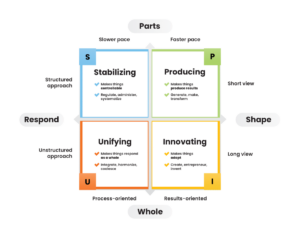
The chart below shows how each basic management style compares to the others. It compares the pace (slow to fast) of how a style tends to act, think, and speak; the time frame (short view to long view) of how a style tends to perceive a situation, trend, or idea; the orientation (process-oriented to results-oriented) of how a style tends to relate to people and situations; and the approach (structured to unstructured) of how a style tends to operate in daily tasks.

The four primary styles of management

The Producer

The Producer (P) has a high drive to shape the environment and is focused on the parts that make up the system. Thus, this style moves at a fast pace, takes a short-term view, is results-oriented, and follows a structured approach. The Producer is focused on what to do now and working hard to get it done quickly. To get an immediate sense of the Producer’s qualities, think of a fast-charging, focused, determined, high-energy person who thrives on working long and hard. That’s a Producer.

The Stabilizer

The Stabilizer (S) has a high drive to respond to the environment and is focused on the parts that make up the system. Therefore, this style moves at a slower pace, takes a short-term view, is process-oriented, and follows a structured approach. The Stabilizer is focused on how to do things and working methodically to get them done the right way. To get an immediate sense of the Stabilizer’s qualities, think of a very structured, process-oriented person who likes to analyze the data before making a decision. This person is highly organized, has outstanding attention to details, and takes their time in their words and actions. That’s a Stabilizer.

The Innovator

The Innovator (I) has a high drive to shape the environment and is focused on the whole system. Consequently, this style moves at a fast pace and is results-oriented like the Producing Force, but takes a long view and operates in an unstructured way. The Innovator is focused on driving change while finding new and better ways of doing things. The lens they use to view the world is, “Why not?” As in, “Why not do it this way?” or “Why not try putting these two things together?” To get an intuitive sense of the Innovator’s qualities, think of a dynamic, creative, big-picture person who has myriad new ideas and is usually excited by the latest one – until a new one strikes again. That’s an Innovator.

The Unifier

The Unifier (U) has a high drive to respond to the environment and is focused on the whole system. Therefore, a Unifier moves at a more measured pace and is process-oriented like the Stabilizer, but takes an unstructured, freewheeling approach and a long view of change like the Innovator. The Unifier is primarily focused on who is involved and the interpersonal dynamics of the group. To get an immediate sense of the Unifier’s qualities, think of a very likeable, gregarious, warm, people person who is in tune with others. That’s a Unifier.

Continue reading

Share the love

The Secret to Managing Everything

Life exists in patterns


The secret to understanding management is this: Complex adaptive systems (such as people and organizations) must (1) shape and respond to changes in the environment and (2) do so as whole organisms, including their parts and sub-parts. If they are unable to do so, they will cease to get new energy from the environment and will perish.

Intuitively, this makes sense. For example, imagine a family of four. If the family is to survive and flourish, it must shape the environment by getting resources such as money, food, and shelter. It must also respond to the environment, including to changes that are economic, societal, ecological, and so on. At the same time, it must pay attention to the all the parts that make up the family system – things like the act of cooking, cleaning, commuting, paying the bills, and taking the kids to school. It must take into account the different and often conflicting needs of the individual family members. It must also give focus to holistic dynamics so that the family acts like a single, unified whole – for example, making sure that there’s plenty of love, warmth, laughter, support, and nurturing for all of its members.

If the family isn’t able to shape or respond to the environment, or if it loses focus on the parts or the whole, it will quickly run into trouble. If the pattern continues, then the family will disintegrate. Just imagine a family that doesn’t have income, or a family that can’t perform its daily routine, or that can’t respond to new economic changes, or whose members are always fighting among themselves. Obviously, it’s not a family you’d want to be a part of. It is not resilient or adaptive to change. It costs all of its members more energy than they get in return. Such a family is on the precipice of complete failure.

The same is true for every organization. It must be constantly shaping and responding to change while focused on the parts and the whole. Therefore, I am going to classify observable behavior, at its most basic level, as either shaping or responding to change while focusing on the whole organization or on its parts or sub-parts. I call this the Adaptive Systems Model of organizational behavior.

The Adaptive Systems Model of organizational behavior

The dimensions of behavior within the Adaptive Systems Model exist on a relative and time-dependent scale. For example, if there’s a high drive to shape the environment, then at the same time, there will be a lower drive to respond to change. If there’s a high drive to focus on the parts, there will be a lower drive to focus on the whole. You can see this in your own life. Notice that, when the daily pressures and actions of work and life consume you, you’re also not simultaneously focused on the big picture. That’s why you periodically “get away from it all,” go on vacation, or take time out to get a new perspective. Notice too that if you’re busy building a new business, you don’t have the time and energy to respond to all the little vicissitudes of life, family, friends, and so on. As the farmer once said, “there’s a season to sow and a season to reap and they don’t happen at the same time.”

All behavior can be viewed and understood through this basic model. Note that I’m not talking about “good” or “bad” behavior, nor about why something is behaving the way it is – only that it is behaving along these relative dimensions. Now that you have an overview of the basic dimensions of behavior, you can use this framework to reveal some amazing insights into the people and situations you’re attempting to manage and to do it more effectively. Here’s how.

Continue reading

Share the love

How Square Went Against Popular Strategic Advice and Won

Square Payments followed a counter-intuitive strategy and so should you.

There’s a popular view among technology startups that a smart business strategy is to build a product that’s designed for the leading industry giant to acquire. It usually sounds something like this: “We’re building the next-generation router that Cisco will need to add to its product line. Our strategy is to build the product, get them to adopt it, and ultimately have them buy us out.” Like a lot of things in life, just because this view is popular, doesn’t mean it’s right. In fact, gearing your strategy towards the leading industry giant is usually dead wrong. Here’s why and how to choose a better strategy.

The Story of Square

You may have heard of a company called Square Payments, Inc. Square is a mobile payment solution company that allows anyone to accept credit card payments using their mobile phone. In just over a year since its launch, the company had nearly $1 billion in processed payments. It has recently accepted an undisclosed investment from Visa, the leading credit card processor. The insider consensus is that, if Square continues to execute its strategy, it will revolutionize how we pay for things in the real world. It could be as disruptive to payments as iTunes was to music. How did this all happen in such a short amount of time?

The story of how Square came to life is a great one. Square was created by Jack Dorsey (Jack also happens to be the co-founder and Executive Chairman of Twitter, but that’s a different story). When you learn the story of Square, it becomes clear that Jack didn’t start out to revolutionize the payments industry. His original goal was much more modest. Dorsey’s former boss and good friend (and eventual co-founder), Jim McKelvey, lost a sale for his hand-blown glass because he had no way of accepting credit cards. The problem was one many people had: the barriers to setting yourself up to accept credit card payments were too high. So Dorsey set about to see if he could create a better system.

Continue reading

Share the love

The Pre-Startup Checklist


Before a startup ever launches, you should have a checklist of critical items in place. These items have nothing to do with writing a business plan or forming the articles of incorporation. In line with the old saying “well begun is half done,” without these basic requirements, the venture won’t get off to a successful start. Even worse, ignoring this checklist can lead to your investing a lot of capital, time, and energy – only to find out that you’re doing the wrong thing, with the wrong team, at the wrong time.

The Real Difference Between Startup and Pre-startup

I’m going to define the core difference between startup and pre-startup using a single word: commitment. Commitment means that the entrepreneur and founding team have taken a real risk to make the business happen. They are clearly and unequivocally in. It’s Dodge City or Bust. Without commitment, the venture will remain stuck in pre-startup mode – as an idea that will never be actualized.

For example, I recently had coffee with an old colleague who wanted to talk about his new “startup.” He had written a business plan, registered a domain name, and was seeking advice on raising capital and building the technology. He was still working at his day job, where he planned to stay while building on the idea in his spare time. As we talked, I could tell that what he really wanted was someone with whom he could discuss the idea – to explore it further and get another perspective. He was still just trying it on and not yet fully committed.

You can always tell if someone is committed to a new venture by his or her actions. Have they taken a significant risk such as quitting their day job or putting their own money into it? Are they excitedly and constantly talking about the opportunity? Are people rallying around their cause and vision? These are all great signs of commitment – and that’s when you know you’re in startup mode. With them, a new business can be born and has a chance of success. Without them, you’re still in pre-startup or it’s a non-starter.

Continue reading

Share the love

The Stages of the Execution Lifecycle

Keep climbing the mountain


Navigating your company up the execution lifecycle 1 and keeping it in optimum shape is a great challenge. This article will show you how to do it successfully.

The stages of the execution lifecycle become easier to understand with a little pattern recognition. Basically, every business must shape or respond to its environment and it must do so as a whole organization, including its parts and subparts. If it doesn’t do this, it will cease to exist. Recognizing this, we can call out four basic patterns or forces that give rise to individual and collective behavior within an organization. They are the Producing, Stabilizing, Innovating, and Unifying (PSIU) forces. Each of these expresses itself through a particular behavior pattern. The combination of these forces causes the organization to act in a certain way.

The four forces of Organizational Physics.

Just like the other lifecycles, the execution lifecycle exists within a dynamic between stability and development. The basic stages of the execution lifecycle are birth, early growth, growth, and maturity and, from there, things descend into decline, aging, and death. The focus within the execution lifecycle should be to have the right mix of organizational development and stability to support the stages of the product and market lifecycles. That is, the lifecycle stage of the surrounding organization should generally match the lifecycle stage of the products and markets. If it’s a startup, the surrounding organization is the entire company. If it’s a Fortune 500 company, this includes the business unit that is responsible for the success of the product as well as any aspects of the parent organization that influence, help, or hinder the success of the product.

The stages of the Execution Lifecycle.

The surrounding organization should act a certain way at each stage of the product/market lifecycle, as you’ll see below. Note that, when a force is or should be dominant, it will be referenced with a capital letter:

• When piloting the product for innovators, the company should be in birth mode and be highly innovative and future-oriented (psIu)
• When nailing the product for early adopters, the company should be in early growth mode and be producing verifiable results for its customers (Psiu)
• When beginning to scale the product for the early majority, the company should be standardized and operations streamlined for efficiency (PSiu)
• When fully scaling the product for the early majority, the company’s internal efficiencies should be harnessed, as well as the capability to launch new innovations and avoid the commodity trap (PSIu)
• When milking the product for the late majority/laggards, the company should use the proceeds from the cash cows to launch new products into new markets that will in turn progress through their own PSIU lifecycle stages.

Continue reading

Share the love

Lifecycle Strategy: The 3 Strategic Follies


There are three classic strategic follies that cause companies to fail in their strategy execution. Essentially, all three strategic follies occur when a company attempts to bypass the long way around the product, market, and execution lifecycles and tries to find shortcuts instead. The three strategic follies are the Face Plant, the Flame Out, and the Lost Opportunity.

The Face Plant

The first folly is what I call the Face Plant. This happens when an entrepreneur is innovating on a product but targeting a commodity market. The company foolishly spends resources to solve a problem that the market views as already having been solved. The company doesn’t establish thought leadership in quadrant 1 and it doesn’t nail it and prove that it can solve the underlying problem in quadrant 2. Therefore, it doesn’t understand the true customer spending priorities and fails to create a product that meets them. It never establishes profit margins in quadrant 3 and so it comes into a commodity market against better-financed and more robust solutions, quickly getting crushed by those vendors with a more complete service offering.

Avoid the Face Plant.

It’s obvious that you don’t want to pilot a product directly into a commodity market. After all, no one in their right mind would invest innovation dollars into land-based telephones today (Note: Some entrepreneur may, in fact, invest in new land-based phones but they would do so by discovering a disruptive opportunity in the process of going the long way around the strategic path). What happens to many entrepreneurs is that they are so focused on product development and product features, that they don’t simultaneously validate and develop a market. They have a product in search of a problem. If the company isn’t testing, selling, and validating its early product prototypes with innovators and early adopters, then it runs a high risk of falling directly into a commodity trap.

Continue reading

Share the love

Lifecycle Strategy: How to Tell if You’re Doing it Right

In my previous post, I introduced the product, market, and execution lifecycles and why a successful strategy must align them. Now we’ll take a look at the four key indicators that will tell you if you’re on the right strategic path. The key indicators, which must be taken into account at each lifecycle stage, are Market Growth Rate, Competition, Pricing Pressure, and Net Cash Flow.

Four key metrics guide the timing and sequence of your strategy: Market Growth Rate, Competition, Pricing Pressure, and Net Cash Flow.

Let’s take a visual walk around the figure above and see how the key indicators work. First, notice that when you’re piloting your product for innovators in quadrant 1 you should be in negative cash flow. The total invested into the product to date should exceed the return. The market growth rate should be low because you’re still defining the problem and the solution for the market. Therefore, the competitors within your defined niche should be few both in number and capabilities. Consequently, the pricing pressure will be high because you haven’t defined the problem or the solution, so you have no ability to charge enough money for it at this stage.

Continue reading

Share the love