
WARNING: Vision & Values Can Kill Your Company

If a true conflict of vision and values exists within the organization, one side must go.
.

There are few things that will destroy momentum within an organization like a conflict in vision and values. This article will explain why this is so, what to do if you have a conflict of vision and values, and how to align or realign a shared sense of vision and values throughout your organization. First, allow me to define what I mean specifically by vision and values.

Making Sense of Vision and Values

Vision is the destination. Values are how we do the work.

Vision is the destination or ultimate outcome the organization is collectively working towards. For example, imagine that you’re a sea captain. Vision would be the destination and outcomes you’re seeking from a successful voyage. Are you sailing to Tahaiti or Vancouver? And what do you hope to gain from a such a voyage? Knowledge? Treasure? Experience? Or simply a ride to a new place? If vision is the destination, then values are the norms of behavior that are deemed acceptable during the voyage. What kind of ship would you run? Would it be clean, orderly, and tight? Or would you sail like a loose band of pirates, with the only moral code to win treasure or walk the plank? How the work is done reveals the values you espouse.

The same concepts hold true for your company. To be effective, an organization needs a shared and compelling vision so that everyone buys into where the organization is sailing and why. The crew has bought into the vision; they understand their role on the voyage; and they’re eager and determined to make it happen. A company also must embody a shared code of values so that everyone is clear on the modes of acceptable behavior and, more importantly, what isn’t acceptable behavior — the kind that will get you walking the plank. Without a compelling vision and clear authentic values, a company will tend to flounder like a ship adrift at sea. It’s just not going to get very far very fast.

What Happens if There’s a Conflict of Vision and Values

A true conflict of vision and values is an extreme situation that can’t be negotiated. That is, if two or more people possess conflicting vision and values, then one of them must go (yes, that means leave the organization). Intuitively, this should make sense. For how can two groups of people get along and work together if they want to head in opposite directions or don’t value the same conduct? For example, if a couple no longer share the same vision and values for their relationship, no amount of counseling is going to save it. It’s best for both parties to part ways and find partners who do share their vision and values. Likewise, if two company co-founders have a genuine conflict of vision and values, one should buy out the other or they should agree to shut the company down. The organization is just not going to make it while that conflict exists. On a global scale, we have seen plenty of conflicts of vision and values in action. Communism and capitalism are perhaps the most flagrant 20th century examples. In cases like this, if one imposes itself on the other, the resistance to change is so great that this usually results in war. Conflicting vision and values are the major reason why peace between Israel and Palestine is so hard to negotiate. Both sides have a fundamentally different vision and values around co-existence. Until that conflict is resolved, no peace treaties, walls, terrorism, or sanctions are going to bring the sides together. However, with shared vision and values, all other conflicts become manageable.

Because it’s so extreme, your best course of action when you suspect a potential conflict of vision and values is to prevent that conflict in advance. There’s an old saying that when the head is rotten, it affects the whole body. Put another way, vision and values tend to flow from the top of the organization down. Therefore, you want to be extra vigilant that those in leadership positions have bought into a common set of vision and values and actually walk the talk. When this occurs, by their very presence, they naturally instill shared vision and values and help to cascade them throughout the organization. Here’s how you accomplish this.

How to Align Vision & Values
Dynasties are built by highly proficient leaders who buy into a shared vision & values.
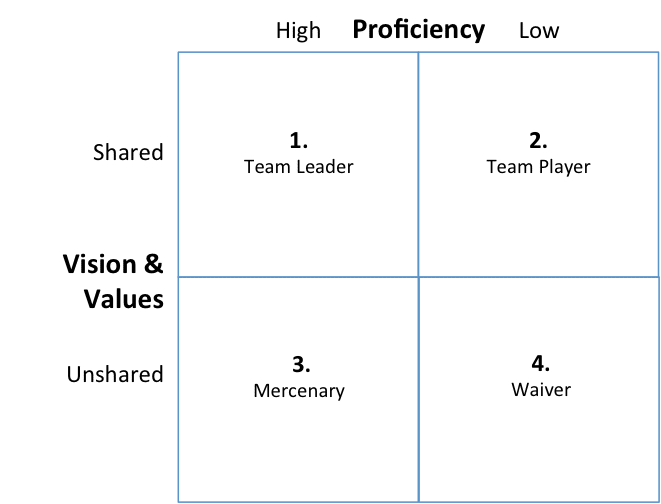
The legendary football coach Bill Walsh used a simple formula to realign the vision and values of the San Francisco 49ers in the 1980s. When Mr. Walsh joined the 49ers, he was a former college coach in his first year of coaching professional football. At the time, the 49ers were infamous for being perennial losers. Nothing in the organization seemed to go right. Mr. Walsh intuitively knew that if he was going to create a Super Bowl champion, then he would first have to change the culture by instilling in his players a new vision and a new set of values. The model he created is powerful in its insight and simplicity. The first step in using it is to place all of your current staff in one of the four quadrants: those who share the vision and values and those who do not, and those who have high proficiency in their tasks (produce results) and those who do not.

Who's on your team?

The Starters in Quadrant 1 are those individuals who exemplify the best that your organization can be. They walk the talk. They embody the desired vision and values of your organization and, at the same time, they have a very high level of proficiency (e.g. their skill in sales, marketing, finance, programming, etc.). When it comes to managing starters, you want to develop their capabilities and career paths for the long term. This is a strategic investment and a smart one. Your job as manager is to help them cultivate their own leadership qualities and find the career path that is most engaging and rewarding to them. Celebrate and honor this group. Include them in strategic planning and the new hire process. They can set the tone and tempo for your entire organization.

The Bench in Quadrant 2 includes those individuals who exemplify the desired culture of your company but who don’t perform at the same level of proficiency as the starters. When it comes to managing the bench, your job is to coach them and train them to improve their proficiency for the task at hand. Invest time, energy, and attention in this group for results today. It is relatively easy to develop proficiency in the short run but it is very, very challenging to develop character in the long run. You either have it or you don’t. Therefore, value those in Quadrant 2 and coach them in technical proficiency.

The Free Agents in Quadrant 3 are those who perform technically at a very high level but who don’t align with the company’s vision and values. This is like a group of mercenaries or free agents. They are in the game only for themselves and everyone knows it. Be careful with this group. Use mercenaries sparingly and in areas that are non-critical for the business but require a specialized skill. But at all costs, do not put mercenaries in leadership positions. If you do, this will have an adverse effect on the entire culture. When it comes to managing free agents, your job is to motivate and create incentives that reward short-term performance. Pay them cash on the barrelhead for a job well done. But do not attempt to win them over by offering a career path, an equity stake, or a leadership position that unduly influences others.

The Waivers in Quadrant 4 include those who don’t perform at a high level and don’t share the desired vision and values of the company either. If this was a sports team, this is the group that you’d place on the waiver wire and hope to trade to your competition. There’s no real point in investing time, energy, and attention in improving skills or attempting to create a shared sense of vision and values. In other words, you can put lipstick on a pig, but it’s still a pig. Do yourself and that person a favor: help them find a new job with a different company that better aligns with their talents, vision, and values. You’ll both be better off.

Using a simple model like this matrix can help you quickly group the types of people in your organization and develop a short- and long-range plan to develop each one. It also brings tremendous clarity in identifying the types of starters you want to attract and what it takes to develop your bench. It also shows you the types of free agent mercenaries who you can use for selected tasks but that you shouldn’t count on to be around for the long term. Finally, this brings clarity to your waiver wire and the types of people who aren’t a good fit for your organization’s culture.

Remember, nothing creates greater misalignment in an organization and slows execution speed than a conflict of vision and values. Therefore, attempt to avoid misalignment by being clear and committed to a powerful vision and authentic values up front. Then fill leadership positions in your team with individuals that intrinsically share that same vision and core values. If you can do this, you’ll have smooth sailing ahead. But if you make the mistake of hiring people who don’t buy into the vision and values, you’ll end up facing mutiny or forcing key members to walk the plank.

Back to The Business Execution Guide

Next to The 5 Classic Mistakes in Organizational Structure: Or, How to Design Your Organization the Right Way

Share the love

  • Sam

    Hi Lex, great article! How do you actually go about setting the vision and values for a company? Meaning, do you have any suggestions on practical steps or a process to follow?

  • Stephanie

    Is it important to be a triple bottom line, five bottom line, etc. company?

  • http://twitter.com/lexsisney Lex Sisney

    Hi Sam, the vision and values are almost always already embedded in the organizational culture. But it usually takes an off-site day with the leadership team to re-discover and clarify them (the reason you need to get offsite is to get away from the daily grind and get a new perspective). Here are a few questions that I like to ask during an off-site that help tease out the vision and values. I’m not certain but I think I picked up these questions from the Encyclopedia of Positive Questions / Appreciative Inquiry:

    1) What most attracted you to work here in the first place? (quickly gets to the emotional heart or real values of an organization).

    2) Think of a time when this organization was at its absolute best… when our stakeholders easily saw who we really are and what we’re really about? (same)

    3) What trends and changes are you seeing in the world that excite you and give you a sense of confidence in the possibilities for the organizations future? (leads to vision)

    4) Given these trends, imagine our organization 5 years from today. What do you see? Be creative as you answer questions such as: What markets do we serve? Who are our key customers? How much revenue and profits do we generate? What products and services do we offer? How many employees do we have? With what skills? How many locations? How do we do our work?

    5) Now, looking back from this position 5 years hence, describe the history of how the organization got to where it is. What decisions were made 5 years ago in order to get us to where we are?

    In addition to vision and values, it’s really valuable to clarify the business purpose/position. I get to that by asking these questions which become a short paragraph:

    Who is the customer? What is their problem? How do we solve it? How do we measure it (prove it)? How do we price it? How do we distribute it/sell it? Why is it important? Who do we compete with? Why are we unique?

    Remember that as you define purpose, vision and values, it’s not what’s written down on the placard in the lobby or added into the annual report. What’s important is how people show up everyday, do the work, where they focus their attention, how they know if they’re doing a good job, how they relate to each other, their understanding of why their work is important, and what makes the culture unique. It’s a feeling of teamwork that if we do things together, the right way, we can accomplish anything.

  • http://twitter.com/lexsisney Lex Sisney

    No, it’s important to be transparent and authentic. I had a coaching client at one time who was really authentic that the company’s number #1 job was to pay him first. Sounds selfish and unacceptable right? The thing is that he told everyone that! “Listen Stephanie, you’re #1 job is to make sure that I get paid every month. If I get paid, then you get paid. We treat our customers right and we operate with total transparency, no BS.” Now this “pay me first” stance flys in the face of conscious business practices, it isn’t heart warming, it’s not giving back to the community or aspiring to make the world a better place, and it certainly isn’t transcendent. But guess what? Everyone involved in the company bought in. The company was successful, people had worked there for years with low turnover, there was low friction. Everyone knew exactly what they were dealing with and were happy with it for that reason. It worked because it was straight up.

  • Mark P.

    Sorry Lex, I totally disagree with this one. Companies like Goldman Sachs and Exxon are basically fucking up the world out of sheer greed. Profit at all costs and the lack of a more balnced approach (people, planet, then profit). It’s destroying our world. Business needs a wake up call, not more selfishness.

  • http://www.OrganizationalPhysics.com Lex Sisney

    Hey Mark, first, I totally get and agree with the notion that relentless pursuit of profit in the short run makes capitalism unsustainable in the long run. And personally, I support a multi-bottom line approach. The point I’m trying to make is that it’s most important to be authentic and transparent in vision and values then to try to be something you’re not. That is, if you’re a CEO who’s only in it for the money, then let it be known that you’re only in it for the money. Really, it’s OK. Don’t go around preaching and pretending “all for one, one for all” or “we aspire to be a 5 bottom line business” if that’s really not true. People value transparency and authenticity from their leaders above all else. It’s OK for a leader to be a a thoughtless cad, as long as everyone, including the leader, knows what they’re really dealing with. But if leadership is found to be saying one thing while doing another, it causes organizational entropy to rise and the organization will be less successful over time.

    Take Exxon for example. Their vision and values is to be the largest and most efficient producer of petroleum reserves. They walk that talk and as a result, are generally feared, often despised, but highly respected (even by those fighting to bring them down) for the profits they generate. Exxon is who it is. BP on the other hand has made a public push to be seen as the “green energy company.” They changed their logo and have made multiple public commitments to clean energy. However, it’s mostly just lip service. As a result, it’s opened itself to ridicule and scorn because its public stance is just not accurate or authentic. Inauthentic values don’t work to coalesce the organizational mass. In fact, it causes more harm than good. So authenticity and transparency is most important no matter what.

  • Anon

    Just saw this on SI by Peter King on the Jets: “I think Rex Ryan’s practice of coddling Santonio Holmes went way too far when he made Holmes a captain before the season, and the Jets are paying for it now. Holmes is far too immature to be a captain. Ryan thought he could turn Holmes into a leader by giving him a position of authority. Instead, it enabled him to act entitled, and his teammates all saw him pouting and acting sullen throughout the game Sunday. Of the many things the Jets have to fix in 2012, Holmes’ attitude and Ryan’s willingness to so easily hand over a position of authority as a carrot to a player he’s trying to motivate is on page one of the list.”

    Put another way… never put a 3 player in a 1 player position. It won’t change their demeanor or make them more responsible. It will only destroy the culture.